
A successful broiler production cycle starts with healthy, high-quality day-old chicks. Whether you are operating a commercial hatchery or purchasing chicks for your poultry farm, knowing how to grade Ross 308 chicks is essential for achieving good growth, low mortality, uniform flock development and profitable production.
We believe that chick quality is one of the most important foundations of successful broiler farming.
In this guide, we explain how to inspect, evaluate and grade Ross 308 day-old chicks, including the physical characteristics to look for, common defects and how to distinguish strong chicks from weaker ones.
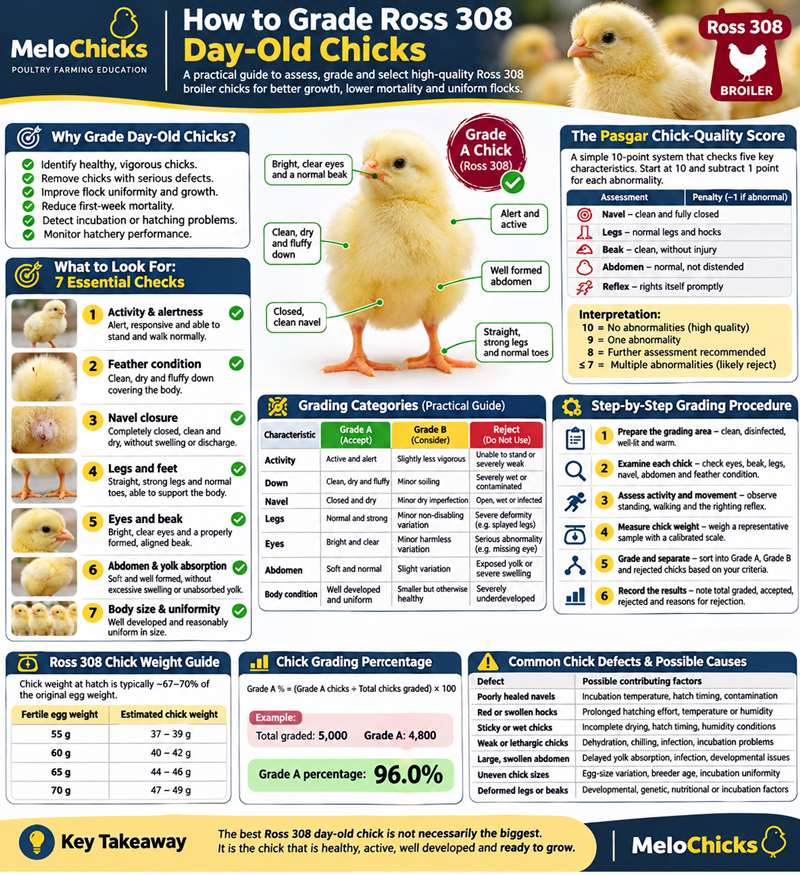
Grading is the process of examining newly hatched chicks and assessing whether they meet the quality standards required for successful broiler production.
1. Why is grading day-old chicks important?
Ross 308 broilers are genetically selected for rapid growth, efficient feed conversion and strong meat production. However, their performance depends heavily on the quality of chicks placed into the brooding house.
Proper grading helps farmers and hatcheries:
- Identify healthy, vigorous chicks suitable for placement.
- Remove chicks with serious physical defects.
- Improve flock uniformity and early growth.
- Reduce avoidable first-week mortality.
- Detect potential incubation or hatching problems.
- Monitor hatchery performance and chick quality over time.
Important: A chick that looks healthy at hatch is not guaranteed to perform well, but poor chick quality increases the risk of problems during brooding.
2. The seven essential checks when grading Ross 308 chicks
1. Activity and alertness
A good-quality chick should be alert, responsive and able to stand and walk normally. It should react to gentle handling and quickly regain its balance when placed on its feet.
Weak, lethargic or unresponsive chicks require closer assessment.
2. Feather condition
Healthy chicks should have clean, dry, fluffy down covering their bodies.
Wet, sticky or matted feathers can indicate incomplete drying, early removal from the hatcher or incubation-related problems.
3. Navel closure
The navel should be completely closed, clean and dry, without swelling, discharge or exposed tissue.
Poorly healed navels increase the risk of bacterial infection, including omphalitis, commonly called yolk-sac infection.
4. Legs and feet
Both legs should be straight, functional and capable of supporting the chick’s body.
Check for splayed legs, twisted toes, swollen joints and difficulty walking. Serious leg defects can prevent chicks from reaching feed and water.
5. Eyes and beak
Eyes should be bright, open and clear. The beak should be properly formed and aligned.
Chicks with missing eyes, severe crossed beaks or other significant abnormalities should not be classified as first-grade chicks.
6. Abdomen and yolk absorption
The abdomen should be soft and reasonably well formed, without excessive swelling, hardness or discoloration.
A large, tense abdomen or unabsorbed external yolk can indicate poor yolk absorption or other hatching problems.
7. Body size and uniformity
Chicks should be well developed and reasonably uniform in size.
Large differences in chick size can indicate variation in breeder egg weight, incubation conditions or hatch timing. Size alone, however, does not determine chick quality.
3. Understanding Grade A, Grade B and rejected chicks
Many hatcheries use a grading system to classify day-old chicks. However, Grade A and Grade B are not universal Ross 308 breed standards. Each hatchery should establish consistent, documented grading criteria.
The following is a practical grading framework.
| Characteristic | Grade A | Grade B | Reject |
|---|---|---|---|
| Activity | Active and alert | Slightly less vigorous | Unable to stand or severely weak |
| Down | Clean, dry and fluffy | Minor soiling | Severely wet or contaminated |
| Navel | Closed and dry | Minor dry imperfection | Open, wet or infected-looking |
| Legs | Normal and strong | Minor non-disabling variation | Severe deformity |
| Eyes | Bright and clear | Minor harmless variation | Serious abnormality |
| Abdomen | Soft and normal | Slight variation | Exposed yolk or severe swelling |
| Body condition | Well developed | Smaller but otherwise healthy | Severely underdeveloped |
Grade B chicks should be evaluated carefully. Some hatcheries may accept minor cosmetic variations, but chicks with significant health, navel or mobility defects should not be sold as healthy day-old broilers.
4. What should a Ross 308 day-old chick weigh?
Chick weight is a useful measurement when assessing hatchery consistency, but it must be interpreted correctly.
The weight of a newly hatched Ross 308 chick depends on breeder age, egg weight, incubation conditions, hatch timing and how long the chick remains in the hatcher.
A common rule of thumb is that chick weight at hatch is approximately 67–70% of the original egg weight, although this varies.
Example chick weights based on egg size
| Fertile egg weight | Estimated chick weight at hatch |
|---|---|
| 55 g | 37–39 g |
| 60 g | 40–42 g |
| 65 g | 44–46 g |
| 70 g | 47–49 g |
These are illustrative estimates, not mandatory Ross 308 grading thresholds. Chicks lose weight through moisture loss after hatching, so the weighing time must be consistent.
A 40 g chick may be perfectly healthy, while a 47 g chick may have a poorly healed navel or other defects.
The objective is not simply to produce the heaviest chick. It is to produce a healthy, vigorous and uniform chick.
5. How to grade chicks using the Pasgar score
The Pasgar scoring method is a structured chick-quality assessment system commonly used in commercial hatcheries.
It evaluates five physical characteristics, with one penalty point assigned for each abnormal characteristic.
The score starts at 10.
| Assessment | Good condition | Penalty |
|---|---|---|
| Navel | Clean and fully closed | −1 if abnormal |
| Legs | Normal legs and hocks | −1 if abnormal |
| Beak | Clean, without red marks or injury | −1 if abnormal |
| Abdomen | Normal, not excessively distended | −1 if abnormal |
| Reflex | Chick rights itself promptly when gently placed on its back | −1 if abnormal |
A score of 10 indicates no defects in the five assessed characteristics. A high score does not override serious clinical abnormalities or biosecurity concerns.
The Pasgar system allows hatcheries to compare chick quality between batches, incubators and different incubation conditions.
For example, if a particular hatcher consistently produces chicks with poor navels or abnormal hocks, the hatchery can investigate incubation temperatures, humidity, ventilation and hatch timing.
6. Step-by-step grading procedure for a hatchery
Step 1: Prepare the grading area
Use a clean, disinfected, well-lit grading surface. Ensure the room is appropriately warm and free from draughts to prevent chilling.
Step 2: Examine each chick
Gently pick up the chick and inspect its eyes, beak, legs, navel, abdomen and feather condition. Avoid squeezing its abdomen.
Step 3: Assess activity and movement
Place the chick on a stable surface and observe its ability to stand, walk and maintain balance. Where appropriate, assess the righting reflex gently and promptly.
Step 4: Measure chick weight
Weigh a representative sample using a calibrated digital scale. Record the average weight, range and variation within the batch.
Step 5: Grade and separate
Separate chicks according to the hatchery’s defined quality criteria. Do not mix chicks with serious defects into saleable batches.
Step 6: Record the results
Record total chicks graded, accepted, rejected and reasons for rejection. Use the results to monitor hatchery performance.
7. Calculate your chick grading percentage
Grading results should be measured for every hatch so that trends can be identified.
The Grade A percentage is calculated as:

Chicks not classified Grade A may include Grade B and rejected chicks. Record these categories separately.
A hatchery should establish its own performance targets using historical data, breeder flock information and agreed customer specifications rather than assuming one fixed grading percentage applies to every batch.
8. Common chick defects and their possible causes
| Defect | Possible contributing factors |
|---|---|
| Poorly healed navels | Incubation temperature, hatch timing, contamination |
| Red or swollen hocks | Prolonged hatching effort, temperature or humidity problems |
| Sticky or wet chicks | Incomplete drying, hatch timing, humidity conditions |
| Weak or lethargic chicks | Dehydration, chilling, infection, incubation problems |
| Large, swollen abdomen | Delayed yolk absorption, infection or developmental problems |
| Uneven chick sizes | Egg-size variation, breeder age, incubation uniformity |
| Deformed legs or beaks | Developmental, genetic, nutritional or incubation factors |
These are possible associations, not definitive diagnoses. Persistent problems should be investigated using hatch records, egg breakout analysis and veterinary or hatchery technical advice.
9. Why grading matters during the first seven days
The first week of a Ross 308 broiler’s life is particularly important because chicks must establish normal feed intake, water consumption and body-temperature regulation.
Even a high-quality chick can perform poorly if brooding conditions are unsuitable.
After placement, farmers should monitor:
- Crop fill at approximately 2, 4, 8 and 24 hours.
- Chick distribution and behaviour.
- Brooding temperature and floor temperature.
- Access to clean drinking water and fresh starter feed.
- Seven-day body weight and flock uniformity.
- Daily mortality and signs of disease.
A useful Ross 308 management objective is to achieve strong early growth, with seven-day body weight commonly targeted at approximately four to five times placement weight, subject to the applicable Aviagen performance objectives and management conditions.