
Buying fertile eggs from a breeder far away can give poultry farmers access to better genetics and breeds that may not be available locally. However, there is an important reality every farmer should understand:
Fertile eggs that have travelled by courier may not hatch as well as eggs collected directly from the farm.
Even when eggs arrive looking perfectly normal, the journey can affect the delicate structures inside the egg. Understanding these risks—and knowing what to do when the eggs arrive—can significantly improve your chances of a successful hatch.
📦 What Happens to Fertile Eggs During Transport?
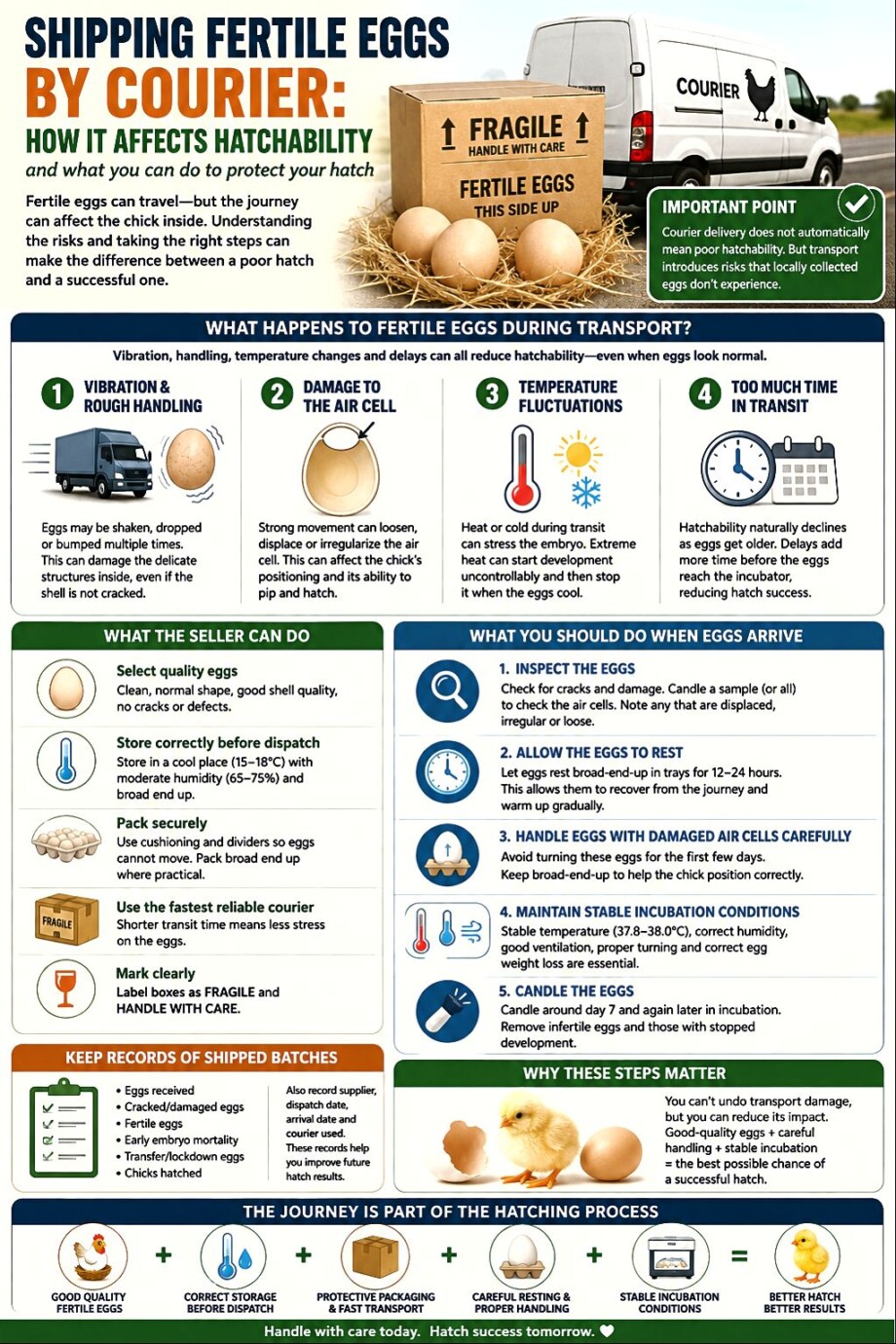
A fertile egg contains a living blastoderm and several delicate internal structures. During courier transport, the parcel may experience repeated vibration, shaking, sudden impacts, temperature changes and delays.
1. Vibration and Rough Handling
Courier vehicles travel over uneven roads, parcels move along conveyor systems, and boxes may be loaded and unloaded several times.
Continuous vibration and sudden shocks can damage the developing potential of the egg even when the shell remains completely intact.
This is why a box of eggs can arrive with no cracked eggs but still produce a lower-than-expected hatch rate.
2. Damage to the Air Cell
One of the most common problems with transported fertile eggs is a loose, displaced or irregular air cell.
Normally, the air cell should remain at the broad end of the egg. Strong movement during transport can partially separate the membranes and cause the air cell to move.
This can interfere with the chick’s positioning and its ability to successfully pip and hatch later in incubation.
3. Temperature Fluctuations
Fertile eggs are sensitive to temperature.
During transport, they may spend time in a hot delivery vehicle, cold warehouse, loading area or courier depot. Repeated temperature changes can reduce embryo viability.
Extreme heat is particularly dangerous because it may cause embryonic development to begin under uncontrolled conditions and then stop when the eggs cool again.
4. Eggs May Spend Too Long in Transit
Fertile eggs naturally lose hatchability as storage time increases.
When courier delays are added to the time between laying, packing and dispatching, the eggs may already be several days old before reaching the customer.
Generally, the sooner fertile eggs can be placed under proper incubation conditions, the better.
🥚 What Can the Seller Do?
Good preparation starts before the courier collects the parcel.
Eggs selected for shipping should ideally be:
• Clean without being aggressively washed
• Normal in shape and shell quality
• Free from cracks and shell defects
• Properly stored before dispatch
• Packed securely with the broad end facing upward where practical
The packaging should prevent individual eggs from moving while also providing cushioning against shocks.
Boxes should be clearly marked as FRAGILE, although farmers should never assume that a fragile label guarantees gentle handling.
Where possible, use the fastest reliable courier service available. Reducing transit time is one of the simplest ways of reducing transport-related risk.
📥 What Should You Do When Couriered Eggs Arrive?
Don’t simply open the box and immediately load the eggs into the incubator.
Step 1: Inspect the Eggs
Check for cracks, damaged shells, leaking eggs and obvious abnormalities.
If possible, candle a sample—or all of the eggs—to examine the air cells.
You may notice air cells that are:
• Normal and firmly positioned
• Slightly displaced
• Irregular
• Loose or moving when the egg is gently tilted
This can give you an indication of how much stress the shipment experienced.
Step 2: Allow the Eggs to Rest
After a stressful journey, allow the eggs to rest broad-end-up in a suitable egg tray before setting them.
A resting period of approximately 12–24 hours is commonly used for shipped eggs.
This also allows eggs that arrived cooler than the incubation room to warm gradually rather than being subjected to another sudden temperature change.
Step 3: Handle Eggs With Damaged Air Cells Carefully
If air cells appear loose or badly displaced, avoid aggressive handling.
Keeping these eggs broad-end-up during the initial incubation period may be beneficial, particularly where air-cell damage is significant.
Step 4: Maintain Stable Incubation Conditions
Couriered eggs have already experienced environmental stress. Once they enter the incubator, the goal should therefore be stability.
Pay particular attention to:
🌡️ Stable incubation temperature
💧 Appropriate humidity
🌬️ Good ventilation and airflow
🔄 Correct egg turning
⚖️ Egg weight loss throughout incubation
Avoid trying to compensate for transport damage by making extreme changes to temperature or humidity. Good incubation management cannot reverse physical damage, but it can prevent additional losses.
🔦 Candle the Eggs During Incubation
Candling becomes particularly useful when working with shipped fertile eggs.
Around day 7, check for normal embryo development and remove clearly infertile eggs or eggs where development has stopped.
A second candling later in incubation can help identify further embryo mortality and provide valuable information about the performance of the batch.
📊 Keep Records of Shipped Batches
If you regularly buy fertile eggs by courier, record:
Eggs received → cracked/damaged eggs → fertile eggs → early embryo mortality → transfer/lockdown eggs → chicks hatched
Also record the supplier, dispatch date, arrival date and courier used.
Over several batches, these records can tell you whether poor hatchability is associated with fertility, incubation management, egg storage or transportation.
For example, if eggs show good fertility but consistently suffer unusually high early embryo mortality after long-distance transport, shipping conditions should be investigated.
🐣 The Important Point
Courier delivery does not automatically mean fertile eggs will hatch poorly. Many shipped eggs hatch successfully.
But transportation introduces risks that locally collected eggs don’t experience.
The objective should therefore be to reduce those risks at every stage:
Good-quality fertile eggs + correct storage + protective packaging + fast transport + careful resting + stable incubation = the best possible chance of a successful hatch.
When buying fertile eggs that need to travel long distances, remember that hatchability depends not only on the incubator. The journey from the breeder to the incubator is also part of the hatching process.
#FertileEggs #EggIncubation #HatchingEggs #PoultryFarming #HatcheryManagement #ChickenFarming #Incubator #PoultryFarmers #Hatchability #BroilerFarming