
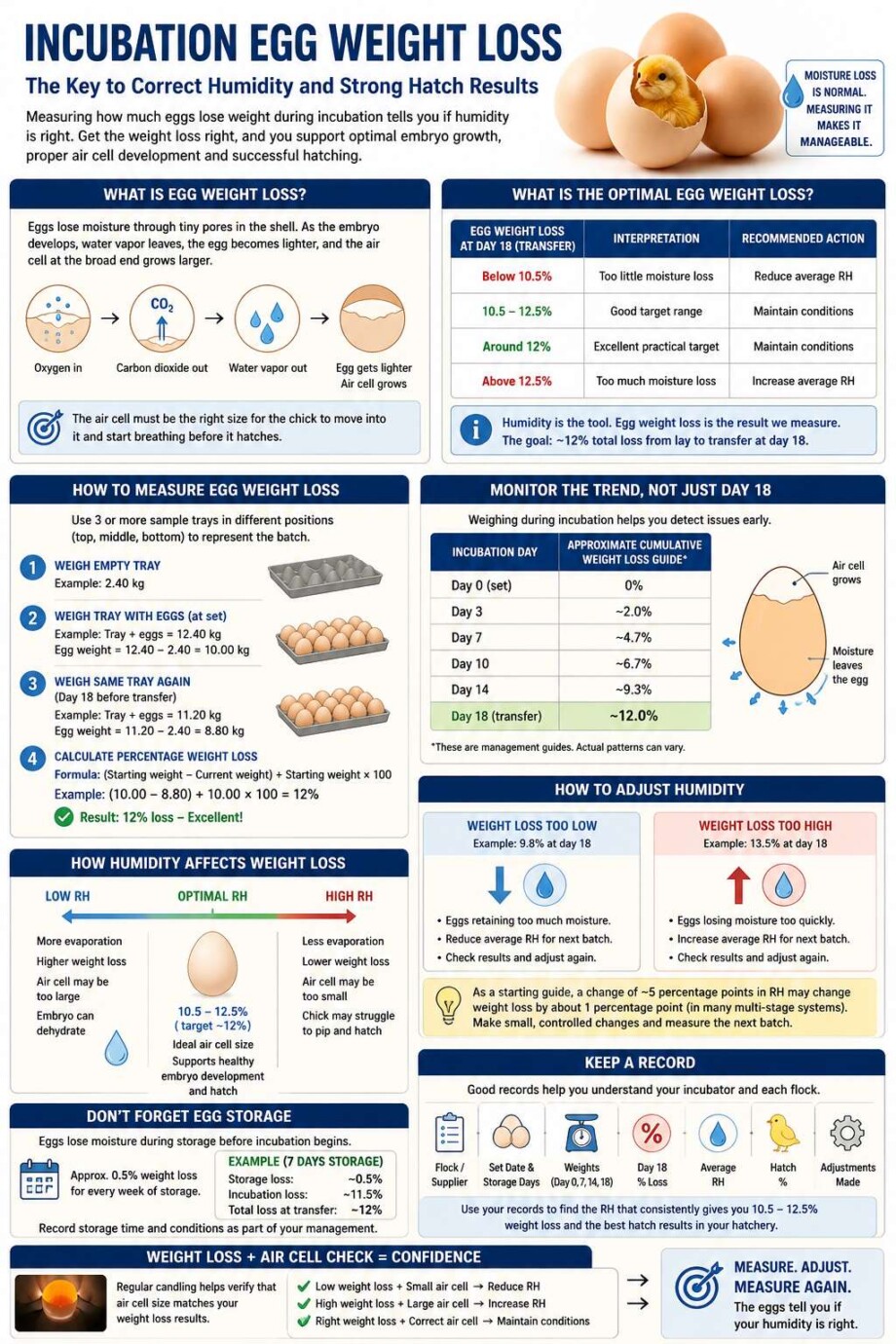
Successful incubation is not only about maintaining the correct temperature and humidity. Egg weight loss is a valuable measurements available to a hatchery.. Measuring how much weight fertile eggs lose during incubation provides a practical way of determining whether humidity is allowing the eggs to lose the correct amount of moisture.
For broiler fertile eggs, a useful target is approximately 10.5–12.5% total egg weight loss from lay to transfer at around day 18, with about 12% being a good practical target.
What Is Egg Weight Loss?
A fertile egg naturally loses moisture throughout storage and incubation. The eggshell contains thousands of microscopic pores through which gases and water vapour can move.
As the embryo develops:
- Oxygen enters the egg.
- Carbon dioxide leaves the egg.
- Water evaporates through the shell.
- The egg gradually becomes lighter.
- The air cell at the broad end of the egg becomes larger.
This moisture loss is necessary for normal embryo development and preparation for hatching.
The developing chick eventually internally pips into the air cell before externally pipping through the shell. The air cell therefore needs to have developed to an appropriate size.
Egg weight loss gives the hatchery a measurable indication of whether this process is occurring correctly.
What Is the Optimal Egg Weight Loss?
For broiler breeder eggs, a practical target at transfer around day 18 is:
| Egg Weight Loss | Interpretation | Recommended Action |
|---|---|---|
| Below 10.5% | Too little moisture loss | Reduce average RH |
| 10.5–12.5% | Good target range | Maintain conditions |
| Around 12% | Excellent practical target | Maintain conditions |
| Above 12.5% | Excessive moisture loss | Increase average RH |
The important point is that humidity is the tool we use to control moisture loss; egg weight loss is the result we should measure.
Simply operating an incubator at a recommended relative humidity does not guarantee that the eggs are losing the correct amount of moisture.
Eggshell quality, breeder age, egg size, storage conditions, ventilation and incubator design can all influence moisture loss.
What Happens When Eggs Lose Too Little Weight?
If eggs are not losing enough weight, they are retaining too much moisture.
For example, if eggs have lost only 9.5% by day 18, the incubator has generally been operating at too high an effective humidity for those eggs.
This can result in an air cell that is smaller than desired and may contribute to difficulties during the final stages of incubation and hatching.
The solution is generally to reduce the average incubator relative humidity so that more moisture can evaporate from the eggs.
What Happens When Eggs Lose Too Much Weight?
The opposite occurs when humidity is too low.
For example, if eggs have lost 14% by day 18, too much moisture has escaped.
The air cell can become excessively large and the embryo can experience excessive dehydration.
In this situation, the average incubator RH should generally be increased for subsequent batches.
The relationship is simple:
Higher RH → Less evaporation → Lower egg weight loss
Lower RH → More evaporation → Higher egg weight loss
How to Measure Egg Weight Loss
You do not have to weigh every egg in the incubator.
A simple and effective approach is to identify several sample trays that will represent the batch.
Where possible, select trays from different positions in the incubator, such as:
- Top
- Middle
- Bottom
This is particularly useful in larger incubators because it can also identify differences in humidity and airflow within the machine.
Step 1: Weigh the Empty Tray
Before loading eggs, weigh the empty incubation tray.
For example:
Empty tray = 2.40 kg
Record this weight.
It is better to weigh each individual sample tray rather than assuming that all trays have exactly the same weight.
Step 2: Weigh the Tray With Eggs
Load the fertile eggs and weigh the complete tray.
For example:
Tray + eggs = 12.40 kg
Subtract the empty tray weight:
12.40 kg − 2.40 kg = 10.00 kg
The starting egg weight is therefore:
10.00 kg
Record this as your starting weight.
Step 3: Weigh the Eggs Again
Weigh exactly the same tray during incubation and again immediately before transfer to the hatcher at approximately day 18.
Suppose the day-18 measurement is:
Tray + eggs = 11.20 kg
Subtract the tray:
11.20 kg − 2.40 kg = 8.80 kg
The eggs therefore now weigh 8.80 kg.
Step 4: Calculate Percentage Weight Loss
Use the following formula:
Egg Weight Loss % = (Starting Weight − Current Weight) ÷ Starting Weight × 100
Using our example:
(10.00 − 8.80) ÷ 10.00 × 100
= 12%
The eggs have therefore lost 12% of their starting weight, which is an excellent result.
Don’t Wait Until Day 18
Although the final day-18 measurement is extremely important, weighing eggs during incubation can help identify problems earlier.
A simple monitoring programme could include measurements at:
| Incubation Day | Approximate Cumulative Weight-Loss Guide* |
| Day 0 | 0% |
| Day 7 | ~4.7% |
| Day 14 | ~9.3% |
| Day 18 | ~12% |
*Intermediate figures are a simple linear management guide. Actual moisture-loss patterns can vary, particularly between single-stage and multi-stage incubation systems.
The most important measurement remains whether the eggs reach the desired total weight loss by transfer.
How to Adjust Humidity Using Egg Weight Loss
Once you start measuring weight loss, humidity management becomes much easier.
Weight Loss Is Too Low
Suppose your eggs have lost:
9.8% by day 18
but your target is:
12%
The eggs are retaining too much moisture.
You should generally reduce average incubator RH for the next batch.
Do not make extreme changes immediately. Make a controlled adjustment, record it and measure the results from the next set.
Weight Loss Is Too High
Suppose your eggs have lost:
13.5% by day 18
against a target of approximately 12%.
The eggs are losing moisture too quickly.
You should generally increase average incubator RH.
Again, make controlled changes rather than large adjustments.
Use Small Adjustments
As a practical starting point, a change of approximately 5 percentage points in RH may change egg weight loss by roughly 1 percentage point in some multi-stage incubation conditions.
For example, if you are obtaining:
13% weight loss
and want approximately:
12%
you might increase the average RH by around 5 percentage points, then measure the next batch and refine the setting.
This should be treated as a starting guideline rather than an absolute rule because every incubator, flock and environment is different.
Remember Egg Storage
Eggs do not start losing moisture only after being placed in the incubator.
Moisture is also lost during storage.
As a general guide, fertile eggs may lose approximately 0.5% of their weight for every week they are stored.
Therefore, if eggs have been stored for seven days before incubation, some of the desired total weight loss has already occurred.
For example:
Storage weight loss: ~0.5%
Incubation weight loss: ~11.5%
Total weight loss: ~12%
This is why storage duration and conditions should form part of your hatchery records.
Keep an Egg Weight Loss Record
Every hatchery should consider maintaining a simple egg weight-loss sheet for each batch.
Record:
- Flock or supplier
- Breed
- Egg collection or production date
- Number of storage days
- Set date
- Sample tray number
- Number of eggs
- Empty tray weight
- Starting egg weight
- Day-7 weight
- Day-14 weight
- Day-18 weight
- Day-18 weight-loss percentage
- Average incubator RH
- Hatch percentage
- Any humidity adjustments made
Over several incubation cycles, this information becomes extremely valuable.
You may discover, for example, that one flock consistently requires slightly higher humidity while another loses moisture more slowly and requires lower humidity.
Don’t Rely on Humidity Alone
It is common for hatchery operators to concentrate on a specific humidity setting, such as 50%, 55% or 60% RH.
However, the humidity displayed by the controller is only part of the picture.
Two incubators operating at exactly the same indicated RH can produce different egg weight-loss results because of differences in:
- Airflow
- Ventilation
- Eggshell quality
- Egg size
- Breeder flock age
- Temperature
- Incubator loading
- Sensor calibration
- Local environmental conditions
The question should therefore not simply be:
“What humidity should my incubator be set at?”
A better question is:
“At what humidity does my incubator produce the correct egg weight loss?”
For example, after several batches you may establish that operating your particular incubator at an average of 52% RH consistently produces 11.5–12% weight loss by transfer.
That becomes valuable information specific to your hatchery.
Combine Weight Loss With Air Cell Observation
Egg weight loss should also be considered alongside candling.
As moisture leaves the egg, the air cell becomes larger. Regular candling can therefore provide a visual indication of whether air-cell development corresponds with the measured weight loss.
If the weight-loss measurement and air-cell development both indicate insufficient moisture loss, there is strong evidence that average incubation humidity should be reduced.
Similarly, excessive weight loss combined with an unusually large air cell indicates that humidity may need to be increased.
Measure, Adjust and Measure Again
Good hatchery management is based on measurement rather than guesswork.
Start with the recommended incubation conditions, but then use your actual hatchery results to refine them:
Measure egg weight → Calculate percentage loss → Compare with target → Adjust humidity → Measure the next batch
The objective is to gradually establish the conditions that consistently produce approximately 10.5–12.5% total egg weight loss by transfer, together with good air-cell development and strong hatch results.
Once egg weight loss becomes part of routine hatchery management, humidity stops being simply a number displayed on the incubator controller. It becomes a parameter that can be adjusted according to what the eggs themselves are telling you.
The incubator controls the humidity, but the eggs tell you whether the humidity is correct.